
The road from risk management to resilience in the age of crisis

Broadly speaking, risk management is about identifying, evaluating and mitigating risks to reduce the likelihood and impact of those risks being realised.

Resilience is also about handling risk, but focuses instead on maintaining business continuity amid adverse events, bolstering an organisation’s ability to rapidly adapt to disruptions, and protecting its people, assets and reputation.

Resilience First, a non-profit founded in 2018 to foster greater business resilience across UK industry and critical infrastructure, has therefore described risk and resilience as “opposite sides of the same coin”.

Both concepts remain fundamental to enterprise strategy, but operational resilience in particular has grown more important in an increasingly unpredictable world where businesses have in recent years been hit by a series of unforeseen dislocations.

Risks motivating the rush to resilience

Threats include growing geopolitical instability, with the ongoing war in Ukraine demonstrating the risks of operating in authoritarian or politically unstable jurisdictions.

Brexit and the rise of populist leaders in several countries, meanwhile, have both threatened to make the trading environment less hospitable through protectionism, trading barriers and immigration restrictions.

And Covid-19 forced organisations, almost overnight, to enable their workforce to work from home and adapt to severe restrictions, such as the food service sector’s sudden reliance on food delivery. The pandemic is still disrupting supply chains and causing industry to question the wisdom of globalisation and the just-in-time (JIT) manufacturing model.

Other threats include rampant inflation, cyber attacks, rapid digitisation and the worsening climate crisis.

The merits of business resilience

In a Resilience First webinar on the topic, Lord Toby Harris has said risk assessments alone leave organisations unprepared “for not only the ‘black swan’ event (previously unobserved, hard to predict, high-impact) but also those ‘black jellyfish’ (known but more complex that may have a sting) and ‘black elephants’ (known and in plain sight but with which no one wants to deal)”.

While risk assessments often centre on a small number of easily understood risks, resilience offers a holistic approach involving scanning the horizon for a variety of threats and modelling crisis scenarios against which to stress-test an organisation.

Far from merely mitigating risk, resilience can therefore inform strategic thinking and give birth to business models more suited to volatile environments.

Barriers to resilience

There’s sometimes a tension between instilling organisational resilience and the imperative to build value and revenues. For instance, abandoning JIT models and building redundancy in supply chains can foster strategic resilience but higher costs are surely unavoidable.

Another barrier to embedding and maintaining operational resilience relates to human psychology. With disruptive crises being rare, it’s all too easy for leaders to lapse into complacency as short-term operational goals consume organisational focus. Moreover, crises typically trigger changes after the fact that mitigate a recurrence of similar adverse events, whereas it’s harder to argue for investments geared to preventing perhaps similarly likely, but more novel, outcomes.

Like many business objectives, achieving resilience is also undermined by business units operating in silos, as well as a lack of collaboration between government, industry and other stakeholders. This is where organisations like the Resilience Rising consortium, which brings organisations including Resilience First and communities together to promote resilience and share best practices, can come in useful. They can help stakeholders solve complex challenges that are difficult to solve on their own.

Finally, as with ESG reporting, targeting strategic resilience is undermined by a lack of universal frameworks for measuring performance quantitatively.

The route to business resilience

The Business Continuity Institute recently predicted that cyber attacks, natural disasters, the mental health crisis and – fuelled by ongoing Covid-19 restrictions in China in particular – supply chain disruptions including a global computer chip shortage, will pose the biggest challenges to strategic resilience in the coming months.

Bolstering your organisation against such threats is an undertaking that encompasses people, processes and technology. Organisations must evolve their culture, training, practices, business models and technical infrastructure accordingly.

Resilience must be organisation-wide, underpinning strategic decisions around risk, finance, operations, technology, human resources, product development and so on.

To give one example, technological and operational resilience was tested by the sudden need to equip employees to work from home at the outset of the pandemic.

Experts advise enterprises to consider not just the immediate impacts of crises but consequences further downstream, too.

It’s also important not to merely ‘fight the last war’ – to prepare for novel or long-forgotten threats as well as recurrences of recent crises.

Covid-19 offers a salutary lesson here. While the pandemic took businesses by surprise it was foreseeable – pandemics are guaranteed to happen, however rarely.

Resilience First also talks of moving beyond a “traditional linear approach to risk management” to a resilience management model that focuses on “preparing for the consequences of dangers in a generic sense rather than the causes of specific dangers which we cannot foretell”.

And, as well as preparing for these “generic dangers”, businesses must have early-warning systems in place to spot their initial signs.

Build your operational resilience

For advice and support on business resilience strategy, contact Mike Wright, Risk Management Consultant at mike.wright@esarisk.com, on +44 (0)343 515 8686 or via our contact form.

New app to help people spot fake profiles online launched

An app aimed at helping people to spot fake profiles on social media sites – Think Before You Link – has been launched by the Centre for the Protection of National Infrastructure (CPNI), which is part of MI5.

Announcing the launch, the CPNI and the Cabinet Office described how “over 10,000 UK nationals” were affected by the use of fake profiles “used by foreign spies and other malicious actors” in the last year, being “targeted on sites such as LinkedIn and Facebook.”

While social media sites themselves do have policies and procedures in place to stop such practice – LinkedIn reportedly “stopped 11.6m fake accounts at registration” in the first half of 2021 – the UK government has seen it as necessary to introduce their own measures to help protect the public and the UK’s interests.

The app is also aimed at those working in and with government. Civil servants are “attractive targets” for malicious activity, with a high risk of receiving “fake offers of lucrative consultancy work if they connect with unknown users.”

What’s in the Think Before You Link app?

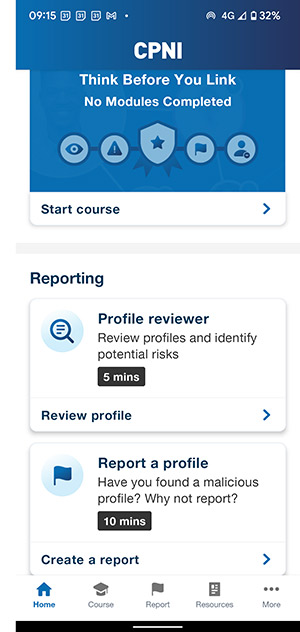
The app, which is part of a wider campaign of the same name, was developed with the help of behavioural scientists and includes a profile reviewer and functionality to report suspicious activity.

think before you link app screenshot
Screenshot from the app
Alongside the profile reviewer and reporting functionality, the Think Before You Link app has a focus on education to raise awareness of potential threats. On first opening the app, users are met with an interactive course that promises to “teach you how to Recognise, Realise, Report and Remove malicious profiles linked to you online.” Completion of the course (which takes around 60-90 minutes) results in the user receiving a certificate which can be shared with, for example, their employer’s cyber security team.

According to new research from the University of Portsmouth, this educational element is needed. Carried out by Professor Mark Button and Dr David Shepherd of the university’s School of Criminology and Criminal Justice, the research surveyed 1,000 UK professionals who use either LinkedIn or Facebook for professional networking. The research shows that, while many LinkedIn and Facebook users are aware of fake profiles, only 64% of them linked this practice with ‘economic espionage’ and more than half of users “could not name a state that posts fake profiles.”

Director General of MI5 Ken McCallum said: “MI5 has seen over 10,000 disguised approaches on professional networking sites from foreign spies… Foreign spies are actively working to build relationships with those working in government, high-tech business and in academia.”

Clearly, the use of fake profiles is viewed as a threat to national security.

The government’s Lead Minister for Cyber Security, Chancellor of the Duchy of Lancaster Steve Barclay said: “The online threat via social media is increasing… It is therefore crucial that we do all we can to protect ourselves and our information… This new app will be an important tool in that endeavour.”

The CPNI Think Before You Link app is available to download from Google Play for Android devices and the App Store for Applie devices.

Cyber security advice, support and training from ESA Risk

For advice and support on a wide range of cyber security issues, please contact us at advice@esarisk.com, on +44 (0)343 515 8686 or via our contact form.

Improve your cyber security awareness and ability to respond to threats with one of our cyber security online courses across levels 1 to 5, including accredited courses and short courses.

What to look for in a litigation support company

Picking the right legal litigation support company can make the difference between success or failure for you and your client.

Litigation support companies provide a wide variety of services in and out of the courtroom. Hiring a company with experience will allow you to leverage their knowledge while making the most of your time.

Read on to learn how a litigation support company can play a crucial role in handling disputes.

Experience matters

Litigation support services companies are essential to helping you prepare a winning case. Their services are so important that you must find a company with experience in the industry.

A business with the right experience will know how the courts operate in the relevant jurisdiction. They will have professional relationships with others in the field, sometimes including court staff. You can leverage the benefits of these relationships throughout your litigation matter.

Focus on your file

Avoid working with a company that has experience but will not keep its focus on your file. The best support service companies will have a large amount of business. They should not sacrifice quality for quantity.

Speak with prospective litigation support companies about how they will make your file a priority. You need assurances that they have the staff in place to fulfil your demands. They must also do it on a time-sensitive basis.

Offer a wide variety of services

Practising law in the litigation field is a high-stakes area of the law where time is of the essence. The easier things are for you and your staff as you prepare during litigation, the more efficient you can be with your time.

Support companies should also help relieve stress and anxiety for your law firm. This goes for whether you are working with the company for a series of depositions, an arbitration, or a courtroom dispute.

Litigation support businesses can help you prepare large amounts of information for presentation to a judge or jury.

You should find one with a wide variety of services they do well.

Finding one company that offers all the services you need makes for a more efficient process and avoids the need to source and onboard multiple suppliers.

You will learn what to expect from a company that you work with over the course of different cases, and they will learn how they can best support you.

Asset tracing

An important part of the litigation process is learning whether a prospective defendant has assets that your client can recover. Even the strongest case may not be one worth taking on if your client has an unrealistic chance of future asset recovery.

Asset tracing is a process by which a litigation support company tracks down recoverable assets. This can include cash, shares, real estate, and other valuable property that a prospective defendant owns. Learning about a potential defendant’s asset profile before moving to litigation will help you and your client gauge whether a case makes financial sense.

A good litigation support company will be able to help with freezing assets and asset recovery, too.

e-Discovery

Most individuals and businesses operate in a digital environment. This can make e-discovery a major part of a litigation matter.

Selecting a litigation support company that has the tools and knowledge to correctly identify, collect and host electronically stored information can be crucial.

Tracing and process serving

Service of process can be a challenging aspect of litigation. Defendants and witnesses may go so far as to conceal their whereabouts to avoid being a part of your case.

A good litigation support company will have the expertise and resources to both trace and serve subjects legally.

Communication counts

In today’s fast-paced legal world, time is money for all parties involved. The digital world makes it easier to communicate with people around the world than ever before.

Despite the advances in technology, not all litigation support firms are equal in this aspect. You should find one that communicates in a way that is the best fit for you and your staff.

Instruct a litigation support company today

At ESA Risk, we provide a wide variety of litigation support services, including people and asset tracing, process serving, digital forensics (e-discovery) and surveillance.

For further details of these services or to instruct us on a matter, contact Mike Wright, Investigations and Risk Management Consultant, at mike.wright@esarisk.com, on +44 (0)343 515 8686, or via our contact form.

The different ways to use a car security GPS tracker

In 2021, the GPS device industry was valued at $1.78 billion globally. That figure is expected to climb to $4.93 billion by 2028.

GPS stands for Global Positioning System, and it’s a system of satellites that transmit signals that allow us to determine our precise location on Earth. GPS is used in various industries, including transportation, navigation, and surveying.

GPS security tracking is one of the most popular uses for GPS today. But exactly how do people use a car security GPS tracker? Here are the six top ways.

Keeping track of your car

Many cars in the UK come with a car security GPS tracker fitted as standard. This is not surprising when you consider the many benefits of GPS security trackers.

GPS trackers help deter thieves by making it easier for the police to locate stolen vehicles. With almost 48,500 vehicles stolen in the UK in 2021 alone, it’s easy to see why trackers are so important.

They can also help owners keep tabs on their car’s whereabouts, which can be particularly useful if you share a car with other family members or if your vehicle is used for business purposes.

In addition, a GPS security tracker for your car offers real-time tracking, meaning you can see exactly where your vehicle is at any given moment. This can be invaluable if your car is involved in an accident or if it breaks down and you need to send out a recovery vehicle.

Tracking cargo during shipping

One of the common ways to use a GPS security tracker is to track high-value cargo during transport. The tracker provides real-time updates on the location of the cargo, so shippers can be confident that their goods are safe and on schedule.

A GPS security tracker can also help prevent theft by deterring would-be criminals and helping law enforcement quickly recover stolen goods.

In addition, some trackers can be used to monitor conditions inside the shipping container, ensuring that delicate items are not damaged in transit.

Keeping track of your children or pets

Have you ever lost track of your kids in a shop or at the park? It’s every parent’s nightmare. That’s why one of the increasingly common GPS security tracker uses is tracking the whereabouts of young children.

Just attach the tracker to their backpack or coat, and you can monitor their location in real-time using your phone. If they ever get lost, you can quickly find them and bring them home safely.

GPS security trackers are also great for keeping tabs on pets. Whether your cat likes to roam around the neighbourhood or you’re worried about your dog getting lost on a hike, a tracker can give you peace of mind.

Plus, if your pet ever does go missing, you can use the tracker to find them quickly.

During hiking or running

GPS security trackers have quickly become one of the most popular tools for hikers and runners everywhere.

When you’re out on a hike or a run through the countryside, it can be difficult to maintain your bearings and stay on track. That’s where a GPS security tracker comes in.

This piece of equipment helps you always know where you are. In addition, a tracker can provide real-time data on your speed and direction, allowing you to make adjustments as needed.

Whether you’re exploring new terrain or simply taking a weekend jog, these powerful accessories can help keep you safe and ensure that you don’t get lost on your adventures.

Navigation when travelling in a new city or country

Navigating a new city or country can be overwhelming. A GPS security tracker can make it easier for you to find your way around unfamiliar streets and neighbourhoods.

A device that provides real-time location data can help you get from point A to point B seamlessly.

As part of a security system to monitor your property

A security system is only as good as its weakest link. But what happens when that weak link is your property itself? How can you be sure your property is safe when you’re not there to watch over it?

The answer may lie in GPS security trackers.

By tracking the location of your valuables, you can rest assured that they are where they’re supposed to be. And if they’re not, you can take steps to recover them before it’s too late. This is a big part of efficient risk management.

Make the most of your car security GPS tracker

Whether you’re looking to keep your belongings safe, monitor your kids or pets, or track your vehicle, there are many different ways to use a car security GPS tracker.

We offer a bespoke GPS security tracker – the Prime 3G GPS Tracker – which can be put to use in a number of different situations.


Boris Becker jailed for 2.5 years

Boris Becker has been sentenced to two years and six months in prison for removing property worth close to €427,000 from his bankruptcy estate. He received 18 months on three other counts, to be served concurrently. In court, the sentencing judge, Her Honour Judge Deborah Taylor, commented that Becker had an undue reliance on his advisors and that he had not shown remorse or humility.

Becker’s sentencing follows his conviction for bankruptcy offences earlier in the month. At the time of his conviction, I wrote a piece answering the question: was this an unusual case?

ESA Risk asset trace investigations

To instruct us on an investigation or for more information on our asset tracing services, contact Mike Wright, Risk Management & Investigations Consultant at mike.wright@esarisk.com, on +44 (0)343 515 8686 or via our contact form.


The use of digital forensic tools in insolvency cases

What is digital forensics?

Digital forensics is a branch of forensics science. It focuses on the recovery and investigation of data stored electronically.

Digital forensics uses specialised tools for data collection and analysis. ‘Computer forensics’ was an earlier name for digital forensics. The term ‘digital forensics’ reflects the fact that many different types of device can store digital data. Sources of digital data include:

  • Computer hard drives
  • Servers
  • Online or cloud-based sources like Google Workplace and Microsoft 365
  • Mobile phones
  • Social media such as Facebook, Instagram, and LinkedIn.

The most common context for digital forensics is to provide evidence in a court of law. Digital forensics professionals must handle digital evidence in a very specific way, otherwise, the court won’t accept it.

Steps in the digital forensics process

The digital forensics process has five steps. Following this procedure helps ensure any evidence will be admissible in court if necessary.

1. Identification

Identifying the evidence is the first step. The digital forensics team will identify what evidence is present. They’ll note where the data is stored and in which format.

2. Preservation

Next, the digital forensics experts will isolate, secure, and preserve the data. This step includes protecting the data from tampering.

3. Analysis

The analysis phase involves a deep, systematic search for relevant evidence. It can include reconstructing fragments of data. Several rounds of examination may be necessary.

The analysts make conclusions based on the evidence they find.

4. Documentation

The fourth step is to create a record of all the visible data. Investigators combine the digital evidence with other evidence documented in photos, sketches, or crime scene maps.

5. Presentation

Finally, the digital forensics team will write a summary of their work.

The report follows forensics protocols. It explains the analysts’ methodologies and procedures as well as their conclusions.

The digital forensics team should write the presentation of evidence and conclusions using terminology a non-specialist can understand.

Development of digital forensic tools

Digital forensic tools have developed significantly in recent decades. Computer forensics began to gain recognition in the 1990s. Early digital forensics investigations used live analysis with the device in question.

However, devices started to contain more and more data. Data interactions have increased by 5,000% since 2010. Relying solely on live analysis is inefficient and impractical.

Modern analysts use a range of sophisticated digital forensics tools. Tools include hardware and software. They can be open source, freeware, or proprietary specialist technologies.

A key feature of digital forensic tools today is automation. For example, tools can filter out duplicate or non-relevant files. This reduces the amount of data that needs investigating.

Types of digital forensic tools

Digital forensics tools can have many different functions. Many modern tools can do multiple tasks. Some tools package hundreds of different functionalities into a single platform.

Each investigation typically needs several types of tools to discover all the relevant evidence.

  • Disk and Data Capture – Disk and data capture tools detect encrypted data on physical drives. They capture and preview the information. They focus on the whole system.
  • File Viewer and File Analysis – File viewers and file analysis tools focus on separate files instead of the entire system. They work to extract and analyse relevant files.
  • Memory Forensics – Analysis of a computer’s file system misses the RAM memory. This volatile memory can have useful information. Sources of information include running processes, network connections, and registry hives. Memory forensics tools work to capture this data.
  • Registry Analysis – The Windows registry is a database for configuration information. It shows how the operating system and its applications are configured. Registry analysis provides information about a user and their activities.
  • Internet and Network Analysis – Network tools let forensic investigators analyse network traffic. They can show what a user was doing online. Tools can capture live traffic or take a saved capture file.
  • Mobile Device Forensics – Mobile forensics tools are specialised tools for mobile devices. They help get data from the internal and external memory of mobile devices. These tools use different methods to bypass device security features like lock screens.
  • Email Analysis – Email analysis tools help with studying the source and content of email messages. They can identify the origin and destination of messages down to the IP address, network provider or ISP, and physical location.
  • Database Forensics – Database forensics tools can analyse data and metadata from a database system. They let analysts see who had access to a database and what those users did. Tools can scan and retrieve deleted data.

Importance of digital forensics for insolvency cases

Digital forensics can play a critical role in insolvency cases. Time is of the essence. If unscrupulous individuals destroy important data, creditors and the court may not see the true picture of a company’s assets. Evidence of unethical activity may disappear.

Digital forensics services can handle the investigation process when you suspect fraud or dishonesty on the part of company stakeholders. In addition to hidden assets, digital forensics can help find people who are trying to evade justice. You can focus on the more technical insolvency aspects of the case.

Choosing the right digital forensics service

Digital forensics can help ensure that your insolvency cases have all the evidence you need. However, choosing the right digital forensics analysts is important to be sure the court will accept your evidence.

You can trust the expert digital forensics analysts at ESA Risk with your insolvency cases. Our digital forensic tools include specialist software that preserves critical metadata. We carry out investigations in an ISO-accredited lab.

Learn more about digital forensics services from ESA Risk and see how we can support your insolvency investigations.

How can AI support corporate investigations?

Corporate investigations can be a complex and lengthy process. The expanding volume of material that may need to be reviewed during an investigation has created a need to use innovative technology to tackle these issues.

Artificial intelligence (AI) is about simulating intelligent human behaviour in computers, such as visual perception, speech recognition, decision-making, and language translation. AI encompasses various technologies, such as natural language processing, deep learning and machine learning.

Managing large amounts of data is a crucial challenge during investigations, and the use of AI can power enhanced data analysis and document review systems. This is what makes AI a particularly transformative tool in the investigations process; it can improve, replace, and accelerate certain investigation efforts, and free up time for more complex tasks.

AI-powered document review systems can perform large-scale reviews, recognise patterns, group by subject and themes, remove unrelated documents, organise timelines, remove duplicates, and sift for relevancy. Casework can be accelerated as evidence is pieced together more quickly.

RAVN and the Serious Fraud Office (SFO)

Managing legal professional privilege disclosure can present a significant challenge in corporate investigations, where law enforcement and regulators are involved. In the SFO’s Rolls-Royce case, an AI document analysis tool, RAVN, was used to analyse an estimated 30 million documents provided by the company. RAVN scanned content that contained potentially privileged material 2000 times faster than a human and removed legally privileged material from admissible files – an incredible time-saving feat.

Through advanced data analytic tools, AI can more effectively organise, categorise, and analyse large, divergent data sources at incredible speed. It can locate and escalate relevant data for review, look for keywords and patterns, evaluate information, and collate a set of results. This reduces the amount of data requiring review, helping investigators focus on the most critical material.

AI can also integrate and query large datasets to connect seemingly disconnected data points, identify key patterns and report irregularities. AI can also proactively detect and flag potentially suspicious activity across platforms and systems.

There has been an evolution in the ways and platforms people use to communicate. This means that patterns may be more important than solitary pieces of evidence during complex investigations. AI can assess communications, transactions and interactions for suspicious trends, and help investigators recognise behavioural patterns across different datasets. These capabilities can lead to more effective evidence compilation and case-building.

Using AI-powered tools and systems in the investigations process can reduce the costs of undertaking corporate investigations in the long-term. It can expedite investigations and enable investigation teams to focus their efforts on more important aspects of investigative work.

Corporate investigations by ESA Risk

Our team of experienced corporate investigators is ready to support you with your investigation needs – from assistance with internal investigations to full-scale corporate investigations as an external investigations agency. We have access to digital forensics and data management technology, like RAVN, to aid investigations that involve large numbers of documents. Please contact Lloydette Bai-Marrow, Serious Fraud and Economic Crime Consultant at lloydette.bai-marrow@esarisk.com, on +44 (0)343 515 8686 or via our contact form for further information.


First published in the Parametric Global Consulting newsletter.

Three lessons from the Amec Foster Wheeler DPA

It was the SFO’s tenth Deferred Prosecution Agreement (DPA) since the DPA regime was introduced in February 2014. The Statement of Facts was released following confirmation by the SFO that it would not be proceeding with prosecutions against any individuals connected to the investigation.

The conduct set out in the Statement of Facts is egregious and endemic. The judge, in approving the DPA, was scathing in his assessment of the conduct of senior leaders at Amec. He noted that, but for the fact that the company had been acquired by an innocent party, the John Wood Group, he would not have granted the DPA. The Statement of Facts offers some valuable insights and lessons for corporates who may find themselves entangled in a law enforcement investigation of a similar nature.

1. Have a clear strategy for dealing with material that is covered by legal professional privilege (LPP)

While the material may properly be cloaked by LPP and does not require disclosure for cooperation credit, it is important to consider whether a limited waiver of LPP is appropriate in the circumstances of the investigation and the alleged offending.

If the company has decided that it will cooperate with the investigation, then it may require a degree of pragmatism over privileged material in its possession that will enable the investigation to proceed at pace and assist the authorities to reach a conclusion.

In Amec, there was a limited waiver of LPP over legal advice that had been received by the company in relation to its dealings with agents and public officials. This waiver was regarded by the SFO as part of the extensive cooperation of the company.

However, the parameters of a limited waiver of LPP should be clearly documented and sufficiently detailed to avoid any misunderstandings as to the extent of the waiver.

2. Policies and procedures don’t effect change, people do

Who is responsible for the effective implementation? Do they have the required visibility into frontline operations? The lack of visibility and access to information can be a major impediment to ensuring that the policies and procedures have the desired effect of managing behaviour and mitigating risk.

In Amec, an Employee Handbook was issued in 2001 which contained a Code of Ethics and set out procedures on the use of agents. In 2004, the company issued a Code of Business Ethics & Conduct and subsequent policies and procedures followed over the years. All were circumvented and disregarded by employees who were determined to continue corrupt practices, without the knowledge of the compliance department. They appeared to have been blind to the “culture of disregard” or powerless to stop it.

Those responsible for implementation of policies and procedures must have the visibility into highest risk operations and the authority to effect change.

3. Avoid ‘paper’ internal investigations and reviews

The simplified essence of an internal investigation is to identify the issue, resolve it and mitigate the risk of reoccurrence.

The collection of factual information that alludes to corporate misconduct and potential criminal offending should be a call to action and not to carry on regardless. Senior leaders should be committed to taking the steps needed to resolve the identified issues and implement measures to stop such conduct from reoccurring.

Amec instructed the same law firm to conduct four separate internal investigations, between 2007 and 2010, into suspicions of bribery in India, Malaysia, Saudi Arabia and Nigeria. Each investigation uncovered evidence of corruption and yet senior employees at Amec did the bare minimum to tackle these issues.

Those who are instructed as an external resource should ensure that they have requisite independence and impartiality, otherwise the investigation is undermined and is an expensive exercise in futility.

Advice and support from ESA Risk

For advice and support on fraud prevention and investigations, please contact Lloydette Bai-Marrow, Serious Fraud and Economic Crime Consultant at lloydette.bai-marrow@esarisk.com, on +44 (0)343 515 8686 or via our contact form.


First published in the Parametric Global Consulting newsletter.

Boris Becker’s bankruptcy: An unusual case?

The six-time grand slam winner and 1992 Olympic champion now potentially faces prison time when he is sentenced at the end of this month.

Becker was made bankrupt in June 2017, when he was unable to repay a debt of more than £3 million owed to Arbuthnot Latham & Co, a private bank. He “was legally obliged to disclose all of his assets so that his trustee could distribute available funds to his creditors.”

However, he has now been found guilty of:

  • Removing property worth more than £350,000
  • Failing to disclose ownership of a property in Germany
  • Concealing a bank loan of nearly £700,000
  • Failing to disclose ownership of 75,000 shares in Breaking Data Corp, a tech firm.

Insolvency investigations in the spotlight

Unsurprisingly, the news of Becker’s 2017 bankruptcy and this three-week trial have received a huge amount of mainstream media coverage. The vast amounts of money involved, unique story elements such as Becker’s assertion that he has lost some of his tennis trophies, and the fact he has been a regular commentator and pundit on UK TV coverage of Wimbledon, have made this a classic celebrity ‘fall from grace’ story. The Guardian’s headline on Friday afternoon was ‘Boris Becker: from tennis greatness to financial disaster’.

From an insolvency investigator’s point of view, this has been a rare occasion where the work we are involved in day-to-day has been outlined for the public in so much detail.

The tangled network of six-figure loans, payments to friends and family, multiple companies, worldwide properties, and discussions about unusual movable assets may appear to be peculiar to this extravagant celebrity’s case. But it isn’t.

We often work on cases like Becker’s, with individuals and companies spinning complex webs of transactions and layers of companies to hide their wealth.

This can make a successful prosecution hard (but not impossible) to achieve. The key, as with all legal cases, is finding the evidence.

This process is known as intelligence gathering and is the basis of asset tracing. As investigators, by conducting thorough forensic research and using techniques such as surveillance, we identify assets such as property, vehicles and valuables owned by the subjects or purchased by the subjects for their family members and close associates.

Proof of ownership or of a beneficial interest in an asset is crucial, as, in most cases, the end goal is to recover assets to settle a debt or as part of litigation. Obtaining proof is not always easy, as assets can be moved from one entity and jurisdiction to another, but there is usually an audit trail that we can follow.

What next for Becker?

Becker, 54, was on trial at Southwark Crown Court, prosecuted by the Insolvency Service on 24 charges. While he was acquitted of 20 of those charges, he was found guilty of concealing, removing and (on two counts) failing to disclose assets.

He was released on bail with sentencing due to take place on 29th April. Each count carries a maximum prison sentence of seven years.

Becker is already subject to a 12-year Bankruptcy Restriction Undertaking until 2031 and his discharge from bankruptcy has been suspended indefinitely.

ESA Risk asset trace investigations

To instruct us on an investigation or for more information on our asset tracing services, contact Mike Wright, Risk Management & Investigations Consultant at mike.wright@esarisk.com, on +44 (0)343 515 8686 or via our contact form.


Legislation update: Economic Crime Act 2022

The Economic Crime (Transparency and Enforcement) Bill became law on 15th March 2022. It was expedited due to recent UK sanctions announced against Russia. The Act is intended to bolster the UK’s response to economic crime threats and is set out in three main parts.

Key features of the Act are:

Part 1: Register of Overseas Entities and their Beneficial Owners

  • It requires overseas entities that own property in the UK to disclose details of their beneficial owners.
  • Companies House will manage the Register.
  • There is a duty to update the Register every 12 months; failure to do so will attract a daily default fine.
  • The overseas entity must take “reasonable steps” to identify registrable beneficial owners and share this information with Companies House.
  • ‘Registrable beneficial owners’ are those that hold 25% or more of the shares in the entity or of the voting rights in the entity, have the right to appoint or remove the majority of the entity’s board of directors, and have the right to exercise or actually exercise significant influence or control over the entity, or over a trust or other entity that meets these conditions.
  • The Act requires the overseas entity to serve an information notice on any possible registrable beneficial owners. A criminal penalty is attached to a failure to comply with the notice, or the provision of false information.
  • The deadline for registration is six months from Parts 1 and 2 of the Act coming into force. It applies retrospectively to property acquired (since 1st January 1999 in England and Wales, and 8th December 2014 in Scotland).
  • Non-compliance will result in criminal liability, with managing officers facing criminal sanctions. Penalties for breaches include fines for the entity and imprisonment for individuals.
  • Overseas entities that have not registered will face restrictions when trying to sell, lease, or deal with their property. This is to deter those who attempt to sell their property to avoid registration.

Part 2: Expanding the remit of the Unexplained Wealth Orders (UWO) regime

  • An enforcement authority will get extra time to review material received in response to a UWO, before discharging interim freezing orders over relevant assets.
  • UWOs are extended to assets ‘obtained through unlawful conduct’ and can be imposed on company directors, even if they do not personally own the assets.
  • The Act creates a new category of persons who can receive a UWO, including ‘responsible officers’ of the entity that owns the property.
  • The ‘responsible officer’ of an entity (that is the subject of a UWO) must provide information to authorities regarding the UWO. They can be directors, board members, general managers, company secretaries, and partners.
  • The Act caps the costs awarded against an enforcement authority if a UWO is challenged successfully.

Part 3: Strengthening the UK sanctions regime

  • The Act will make it easier for the government to impose sanctions on companies and individuals. The UK government can now make designations of sanctioned persons much more quickly, especially for those already sanctioned by other countries.
  • The Office of Financial Sanctions Implementation (OFSI) has new powers to publicly identify organisations and individuals that breach financial sanctions, even if they are not the subject of a penalty. They can also ‘name and shame’ companies or individuals that they consider likely to have breached compliance of obligations or financial sanction prohibitions. This enhances the risk of damage to reputation.
  • The Act makes it easier for OFSI to impose penalties for sanctions breaches on a strict liability basis, rather than having to demonstrate that an organisation had knowledge or reasonable grounds to suspect sanctions were being breached.
  • Lack of compliance with sanctions legislation already constitutes a criminal offence subject to fines and imprisonment.

What next?

Governance and controls should be examined thoroughly to ensure that they align with the Act. In particular, the risk of incurring a financial penalty for a sanctions breach is now much higher. The Act is far from perfect, but it is a step in the right direction. There are clear gaps present, and it is questionable whether enforcement authorities will be given the resources to utilise new powers effectively. The six-month period for registration also leaves room for disposing or transferring illegitimate assets. We should expect another Economic Crime Bill to follow soon to deal with the lacunas in this Act.

First published in the Parametric Global Consulting newsletter.

Advice and support from ESA Risk

For advice and support on economic crime issues, please contact Lloydette Bai-Marrow, Serious Fraud and Economic Crime Consultant at lloydette.bai-marrow@esarisk.com, on +44 (0)343 515 8686 or via our contact form.

Deep dive for the answers you need
Or contact us on +44 (0)343 515 8686 or at advice@esarisk.com.

Deep dive for the
answers you need

Lawyers, accountants, advisors, investors, senior
management. You name them, we help them find the answers
they need. Ready to discover how we can help you?