Two related companies wound-up after defrauding local authorities

Discreet investigations by the Insolvency Service led to two connected companies being wound-up in court on 26th April 2022 for abusing loan and grant schemes during the Covid-19 pandemic.

Momz Love Limited and Unique Homes Lettings, both with registered office addresses in South East London, defrauded multiple local authorities to take advantage of government relief packages.

The retailer, Momz Love, sold the unusual mix of “children’s clothes online and 3D printers and computing equipment from a physical shop.” The company obtained “at least £85,000” in government grants through five successful applications – with one or more further applications rejected – between June and August 2020.

Unique Homes Lettings “fraudulently claimed to be the landlord of entities”, including Momz Love, supporting the retailer’s claim that it occupied various premises used in the company’s false loan applications.

Edna Okhiria, Chief Investigator for the Insolvency Service, noted that “investigators could not find any evidence of legitimate trading by either” company.

Additionally, Unique Homes Lettings stole £8,000 or more by using “stolen cards to make payments to at least four local authorities towards business rates before asking for a refund to be paid into a different bank account.” The ‘payments’ failed, of course, leaving the local authorities paying out a “bogus refund” each time.

This was systemic fraud by both companies that continued until the Insolvency Services received complaints about the businesses.

Lynda Copson, Chief Investigator for the Insolvency Service, described the companies as being “maliciously used as vehicles to defraud local authorities across the country.”

Okhiria outlined how Momz Love used “bogus tenancy agreements to suggest the companies operated in the local area [of each local authority], as well as sham utility bills, bank statements and insurance documents.”

Both companies are now in liquidation, with the Official Receiver hoping to achieve a return for creditors.

This is the latest in a line of Covid support-related announcements made this month by the Insolvency Service, following bans for a director who abused the Eat Out to Help Out and furlough schemes, and for two directors who falsely applied for Bounce Back Loans, as well as a bankrupt being given additional restrictions for a bogus Bounce Back Loan application.

Fraud investigations by ESA Risk

If you suspect that a fraud has occurred within your business and need advice or support on the next steps, we’re here to help.

Contact Mike Wright, Risk Management & Investigations Consultant, at mike.wright@esarisk.com, on +44 (0)343 515 8686 or via our contact form, to find out more.

Bankrupt handed additional restrictions for bogus Bounce Back Loan application

Salih Ozhot, 39, has been placed under eight years of additional bankruptcy restrictions after obtaining a loan from the Bounce Back scheme for a company that had never traded.

The Official Receiver was acting as Ozhot’s trustee in bankruptcy when they found he had successfully applied for a £50,000 bounce back loan for Kangaroo Courier Services, despite the fact “the business never traded and was ineligible for government support.”

Ozhot petitioned for his bankruptcy which was declared on 13th October 2021.

He spent £15,000 of the loan on creating a website for Kangaroo Courier Services, which was apparently formed in November 2019.

The Official Receiver, Mitzi Mace, asked for Ozhot’s bankruptcy restrictions to be extended “due to the risk he posed to creditors”.

She said that “Ozhot’s actions indicated a cavalier approach to business” after he “cynically applied for government support, intended to help viable businesses during the pandemic, for a business that didn’t even exist.”

Mace is now looking to recover the loan from Ozhot’s available assets.

Ozhot’s new bankruptcy undertaking runs from 11th May 2022 for eight years and restricts him from becoming “a company director without the court’s permission” and “from being able to borrow more than £500 without disclosing his bankrupt status.”

The news comes a few days after the release of the latest corporate and individual insolvency statistics for England and Wales, which show a 23.3% year-on-year increase in personal insolvencies. May 2022’s 10,476 personal insolvencies is also 11.2% higher than April’s figure.

Responding to the statistics, Christina Fitzgerald, President of R3, the insolvency and restructuring trade body, noted that “wages haven’t kept pace with inflation, and many people remain very worried about how they’ll manage to afford food, fuel and energy as all three of these necessities become increasingly expensive.

“People’s finances have been affected by the economic fallout from the pandemic, and combined with the increased cost of living, there are potentially a lot of people who are vulnerable to the kind of unexpected shocks that can lead to them becoming insolvent.”

While the number of corporate insolvencies decreased from April to May 2022, there was a huge 79.2% increase compared to this time last year (1,817 insolvencies in May 2022, up from 1,014 in May 2021), reflecting the current uncertainty faced by businesses in a challenging market.

Insolvency and debt investigations

Seeing the whole picture in insolvency and debt cases is key to maximising returns to creditors. For more information on how ESA Risk can help to identify hidden assets or locate targets who have gone to ground, contact Mike Wright, Investigations and Risk Management Consultant, at mike.wright@esarisk.com, on +44 (0)343 515 8686 or via our contact form.

You can also learn more from our Insolvency & Debt Investigations brochure:


Two more directors disqualified for Bounce Back Loan violations

The directors of Ace Buildings and Maintenance Services Limited have been banned from running companies for 11 years, after an Insolvency Service investigation found they falsely applied for £100,000 under the Bounce Back Loan Scheme.

This is the second such announcement from the Insolvency Service in the space of two weeks – the director of a Manchester-based takeaway who abused the Eat Out to Help Out and furlough schemes was banned for seven years earlier this month.

David Harrison and Paul Hudson, from Devon, obtained a £50,000 bounce back loan in May 2020, but failed to declare that their business was in the midst of a company voluntary arrangement (CVA).

Furthermore, the directors made a second application to the scheme for another £50,000 loan, despite the fact they had already received the maximum allowance and their company was still in insolvency.

Ace Buildings and Maintenance Services Limited owed around £110,000 when it entered into a CVA in February 2020. Despite taking out the £50,000 loan, the company fell into liquidation in December of the same year “with the company stating liabilities of more than £340,000.”

That creditors voluntary liquidation (CVL) triggered an Insolvency Service investigation, which eventually led to both directors receiving disqualifications.

“11 years is a substantial amount of time to be removed from the corporate arena and their disqualifications will protect the public and creditors, while also serving as a clear warning to other rogue directors that we will robustly tackle financial misconduct”, said Mike Smith, Chief Investigator for the Insolvency Service.

Ace Buildings and Maintenance Services Limited – incorporated in June 2017 – had a short but tumultuous existence, with a winding-up petition served against the company as early as October 2019.

The company’s liquidators, KJG (part of the Xeinadin Group), are assessing ways to recover the Bounce Back Loan funds, as well as money owed to other creditors.

Smith also noted that “Bounce back loans provided a vital lifeline to help viable businesses during the pandemic. David Harrison and Paul Hudson, however, cynically applied for government support they were not entitled to when they were fully aware their company was insolvent and was not able to pay its debts.”

Harrison’s disqualification runs from 31st May 2022, and Hudson’s ban started on 9th June.

Insolvency and debt investigations

Seeing the whole picture in insolvency and debt cases is key to maximising returns to creditors. For more information on how ESA Risk can help to identify hidden assets or locate targets who have gone to ground, contact Mike Wright, Investigations and Risk Management Consultant, at mike.wright@esarisk.com, on +44 (0)343 515 8686 or via our contact form.

You can also learn more from our Insolvency & Debt Investigations brochure:


Bankruptcy restrictions for former footballer

Former professional footballer, Danny Guthrie, has been given six-year bankruptcy restrictions after choosing to repay gambling debts ahead of other creditors, while in the knowledge that he was insolvent.

Guthrie, who made more than 200 appearances in the Premier League and Football League for clubs including Newcastle United and Liverpool, borrowed £75,000 from a friend in 2019. He subsequently fell into £120,000 of gambling debt.

After making £160,000 from the sale of a property in August 2020, Guthrie “chose to repay his gambling debts ahead of other creditors by making several cash withdrawals despite knowing he was insolvent.”

Guthrie – now a coach with The Football Academy in Dubai – accepted a six-year bankruptcy undertaking, placing him under various restrictions. As a result, he cannot “borrow more than £500 without disclosing his bankrupt status”, nor can he “act as a company director without the court’s permission.”

The 35-year-old came through the youth teams at Manchester United and Liverpool before playing for a string of clubs in England, Indonesia and Iceland. He played four times for England Under-16s.

In relation to this case, the Official Receiver at the Insolvency Service, Kevin Read, said “Danny Guthrie’s actions were deliberate in dissipating assets, at a time he was already insolvent, and to the loss of his creditors. This extension of bankruptcy restrictions should serve as a warning that the Insolvency Service will take action to tackle such financial wrongdoing.”

Guthrie is not the first, nor the most high-profile former sportsperson to hit the headlines due to bankruptcy – this announcement comes only a few weeks after former tennis player Boris Becker was sentenced to two and a half years in prison for bankruptcy offences.

Guthrie’s bankruptcy undertaking runs until May 2028.

Insolvency and debt investigations

Seeing the whole picture in insolvency and debt cases is key to maximising returns to creditors. For more information on how ESA Risk can help to identify hidden assets or locate targets who have gone to ground, contact Mike Wright, Investigations and Risk Management Consultant, at mike.wright@esarisk.com, on +44 (0)343 515 8686 or via our contact form.

You can also learn more from our Insolvency & Debt Investigations brochure:


Latest judgment against director who abused Covid-19 support schemes

Ifraz Nabi ran New York Krispy Fried Chicken on Stockport Road, Greater Manchester, until its liquidation in November 2020. The insolvency process triggered an Insolvency Service investigation which uncovered Nabi’s abuse of the government’s Cvoid-19 support schemes.

Nabi’s business claimed £30,000 through the Eat Out to Help Out scheme and more than £20,000 through the Coronavirus Job Retention (furlough) Scheme. However, there was insufficient evidence of sales made during the qualifying period and “no explanation of how such sales could have been achieved while staff were on furlough.”

Additionally, the takeaway would not have qualified for Eat Out to Help Out funding, anyway, as the scheme was for restaurants with indoor seating and New York Krispy Fried Chicken had few indoor seats and received most of its orders through food delivery apps.

On top of his abuse of the pandemic relief schemes, Nabi did not register the business for tax and liquidators “were unable to assess how much the company owed in unpaid tax”. Nabi “admitted failing to maintain, preserve or deliver up adequate accounting records, as well as failing to register and account for VAT as required”, resulting in his disqualification from holding directorships for seven years. The disqualification is effective from 31st May 2022.

In relation to the case, the Insolvency Service’s Deputy Head of Investigations, Nina Cassar noted that “[o]ne of the main purposes of the Company Director’s Disqualification Act is to ensure that company directors adhere to minimum standards.” She warned that “the Insolvency Service will take action against those who abuse their position and do not take their obligations seriously.”

This is the latest Covid support scheme-related disqualification following an investigation by the Insolvency Service. It is no secret that millions of pounds from relief schemes were misappropriated by company directors – many more cases like this one will be uncovered as insolvency proceedings trigger further investigations in the future.

Fraud investigations by ESA Risk

If you suspect that a fraud has occurred within your business and need advice or support on the next steps, we’re here to help.

Contact Mike Wright, Risk Management & Investigations Consultant, at mike.wright@esarisk.com, on +44 (0)343 515 8686 or via our contact form to find out more.

New app to help people spot fake profiles online launched

An app aimed at helping people to spot fake profiles on social media sites – Think Before You Link – has been launched by the Centre for the Protection of National Infrastructure (CPNI), which is part of MI5.

Announcing the launch, the CPNI and the Cabinet Office described how “over 10,000 UK nationals” were affected by the use of fake profiles “used by foreign spies and other malicious actors” in the last year, being “targeted on sites such as LinkedIn and Facebook.”

While social media sites themselves do have policies and procedures in place to stop such practice – LinkedIn reportedly “stopped 11.6m fake accounts at registration” in the first half of 2021 – the UK government has seen it as necessary to introduce their own measures to help protect the public and the UK’s interests.

The app is also aimed at those working in and with government. Civil servants are “attractive targets” for malicious activity, with a high risk of receiving “fake offers of lucrative consultancy work if they connect with unknown users.”

What’s in the Think Before You Link app?

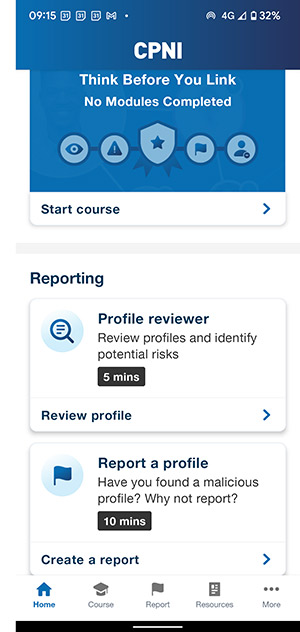
The app, which is part of a wider campaign of the same name, was developed with the help of behavioural scientists and includes a profile reviewer and functionality to report suspicious activity.

think before you link app screenshot
Screenshot from the app
Alongside the profile reviewer and reporting functionality, the Think Before You Link app has a focus on education to raise awareness of potential threats. On first opening the app, users are met with an interactive course that promises to “teach you how to Recognise, Realise, Report and Remove malicious profiles linked to you online.” Completion of the course (which takes around 60-90 minutes) results in the user receiving a certificate which can be shared with, for example, their employer’s cyber security team.

According to new research from the University of Portsmouth, this educational element is needed. Carried out by Professor Mark Button and Dr David Shepherd of the university’s School of Criminology and Criminal Justice, the research surveyed 1,000 UK professionals who use either LinkedIn or Facebook for professional networking. The research shows that, while many LinkedIn and Facebook users are aware of fake profiles, only 64% of them linked this practice with ‘economic espionage’ and more than half of users “could not name a state that posts fake profiles.”

Director General of MI5 Ken McCallum said: “MI5 has seen over 10,000 disguised approaches on professional networking sites from foreign spies… Foreign spies are actively working to build relationships with those working in government, high-tech business and in academia.”

Clearly, the use of fake profiles is viewed as a threat to national security.

The government’s Lead Minister for Cyber Security, Chancellor of the Duchy of Lancaster Steve Barclay said: “The online threat via social media is increasing… It is therefore crucial that we do all we can to protect ourselves and our information… This new app will be an important tool in that endeavour.”

The CPNI Think Before You Link app is available to download from Google Play for Android devices and the App Store for Applie devices.

Cyber security advice, support and training from ESA Risk

For advice and support on a wide range of cyber security issues, please contact us at advice@esarisk.com, on +44 (0)343 515 8686 or via our contact form.

Improve your cyber security awareness and ability to respond to threats with one of our cyber security online courses across levels 1 to 5, including accredited courses and short courses.

Boris Becker jailed for 2.5 years

Boris Becker has been sentenced to two years and six months in prison for removing property worth close to €427,000 from his bankruptcy estate. He received 18 months on three other counts, to be served concurrently. In court, the sentencing judge, Her Honour Judge Deborah Taylor, commented that Becker had an undue reliance on his advisors and that he had not shown remorse or humility.

Becker’s sentencing follows his conviction for bankruptcy offences earlier in the month. At the time of his conviction, I wrote a piece answering the question: was this an unusual case?

ESA Risk asset trace investigations

To instruct us on an investigation or for more information on our asset tracing services, contact Mike Wright, Risk Management & Investigations Consultant at mike.wright@esarisk.com, on +44 (0)343 515 8686 or via our contact form.


Legislation update: Economic Crime Act 2022

The Economic Crime (Transparency and Enforcement) Bill became law on 15th March 2022. It was expedited due to recent UK sanctions announced against Russia. The Act is intended to bolster the UK’s response to economic crime threats and is set out in three main parts.

Key features of the Act are:

Part 1: Register of Overseas Entities and their Beneficial Owners

  • It requires overseas entities that own property in the UK to disclose details of their beneficial owners.
  • Companies House will manage the Register.
  • There is a duty to update the Register every 12 months; failure to do so will attract a daily default fine.
  • The overseas entity must take “reasonable steps” to identify registrable beneficial owners and share this information with Companies House.
  • ‘Registrable beneficial owners’ are those that hold 25% or more of the shares in the entity or of the voting rights in the entity, have the right to appoint or remove the majority of the entity’s board of directors, and have the right to exercise or actually exercise significant influence or control over the entity, or over a trust or other entity that meets these conditions.
  • The Act requires the overseas entity to serve an information notice on any possible registrable beneficial owners. A criminal penalty is attached to a failure to comply with the notice, or the provision of false information.
  • The deadline for registration is six months from Parts 1 and 2 of the Act coming into force. It applies retrospectively to property acquired (since 1st January 1999 in England and Wales, and 8th December 2014 in Scotland).
  • Non-compliance will result in criminal liability, with managing officers facing criminal sanctions. Penalties for breaches include fines for the entity and imprisonment for individuals.
  • Overseas entities that have not registered will face restrictions when trying to sell, lease, or deal with their property. This is to deter those who attempt to sell their property to avoid registration.

Part 2: Expanding the remit of the Unexplained Wealth Orders (UWO) regime

  • An enforcement authority will get extra time to review material received in response to a UWO, before discharging interim freezing orders over relevant assets.
  • UWOs are extended to assets ‘obtained through unlawful conduct’ and can be imposed on company directors, even if they do not personally own the assets.
  • The Act creates a new category of persons who can receive a UWO, including ‘responsible officers’ of the entity that owns the property.
  • The ‘responsible officer’ of an entity (that is the subject of a UWO) must provide information to authorities regarding the UWO. They can be directors, board members, general managers, company secretaries, and partners.
  • The Act caps the costs awarded against an enforcement authority if a UWO is challenged successfully.

Part 3: Strengthening the UK sanctions regime

  • The Act will make it easier for the government to impose sanctions on companies and individuals. The UK government can now make designations of sanctioned persons much more quickly, especially for those already sanctioned by other countries.
  • The Office of Financial Sanctions Implementation (OFSI) has new powers to publicly identify organisations and individuals that breach financial sanctions, even if they are not the subject of a penalty. They can also ‘name and shame’ companies or individuals that they consider likely to have breached compliance of obligations or financial sanction prohibitions. This enhances the risk of damage to reputation.
  • The Act makes it easier for OFSI to impose penalties for sanctions breaches on a strict liability basis, rather than having to demonstrate that an organisation had knowledge or reasonable grounds to suspect sanctions were being breached.
  • Lack of compliance with sanctions legislation already constitutes a criminal offence subject to fines and imprisonment.

What next?

Governance and controls should be examined thoroughly to ensure that they align with the Act. In particular, the risk of incurring a financial penalty for a sanctions breach is now much higher. The Act is far from perfect, but it is a step in the right direction. There are clear gaps present, and it is questionable whether enforcement authorities will be given the resources to utilise new powers effectively. The six-month period for registration also leaves room for disposing or transferring illegitimate assets. We should expect another Economic Crime Bill to follow soon to deal with the lacunas in this Act.

First published in the Parametric Global Consulting newsletter.

Advice and support from ESA Risk

For advice and support on economic crime issues, please contact Lloydette Bai-Marrow, Serious Fraud and Economic Crime Consultant at lloydette.bai-marrow@esarisk.com, on +44 (0)343 515 8686 or via our contact form.

Remaining temporary insolvency restrictions lifted

Restrictions on winding up petitions, which raised the debt threshold to £10,000 or more and required creditors to give debtor businesses 21 days to respond to alternative proposals before seeking a winding up order have now been lifted.

The measures were introduced in October 2021, replacing previous temporary changes that had been in place since early in the pandemic.

When announcing the measures, the Insolvency Service stated they would “be in force until 31st March 2022″, but many temporary arrangements put in place to respond to the impact of Covid were extended beyond their original end dates. In this case, it seems the government has decided circumstances are close enough to ‘normality’ again to end the restrictions as planned.

It is difficult to tell what effect the changes will have on insolvencies. While the debt threshold was raised significantly from £750 to £10,000, it only applied to single debts, meaning the threshold could still be reached through the sum of multiple debts owed to one creditor or of debts owed to a group of creditors. The restriction still offered added protection to many businesses, of course, especially smaller companies which were more likely to have been impacted by Covid.

Whatever the impact on the insolvency market, the changes are the latest indication from the government that it is returning to ‘business as usual’.

In a related announcement, Business Minister Paul Scully confirmed that the general moratorium on commercial evictions has ended and “a new law is now in place to help resolve certain remianing commerical rent debts accrued because of the pandemic”.

The Commercial Rent (Coronavirus) Act 2022 makes available a legally binding arbitration process to commercial landlords and tenants who have not reached an agreement. The law applies to businesses forced to close, or whose activities were heavily restricted, as part of the government’s Covid restrictions. It protects eligible firms from eviction for a further six months.

Instruct ESA Risk today

If you’re looking for an experienced company to reliably serve documents, including winding up peititions, look no further than ESA Risk. Our extensive network of process servers covers the whole of the UK (as well as overseas locations).

Need to confirm an address before sending documents? We also provide tracing services, ensuring you serve the right people in the right place at the right time.

Email us at process.serving@esarisk.com, or call us on +44 (0)343 515 8686.

Boost cyber standards now, urges government

The UK government is encouraging businesses and charities to strengthen their cyber security, in the light of the Cyber Security Breaches Survey 2022 report commissioned by the Department for Digital, Culture, Media and Sport (DCMS).

Based on a survey conducted by Ipsos MORI between October 2021 and January this year, the report shows that 39% of businesses and 30% of charities experienced cyber attacks or cyber security breaches in the last 12 months.

While these numbers are in line with 2021 levels, the frequency of attacks is increasing. Of those suffering attacks, 31% of businesses and a quarter of charities “said they now experience breaches or attacks at least once a week.”

“It is vital that every organisation take cyber security seriously as more and more business is done online and we live in a time of increasing cyber risk.

No matter how big or small your organisation is, you need to take steps to improve digital resilience now…”

Cyber Minister Julia Lopez

The report was ordered as part of the government’s National Cyber Strategy, which aims to protect the UK from cyber threats “by investing in cyber skills, expanding the country’s offensive and defensive cyber capabilities, and prioritising cyber security in the workplace, boardrooms and digital supply chains.”

Other figures from the survey are more positive, with 82% of senior managers in UK businesses listing the priority level of cyber security as ‘very high’ or ‘fairly high’, compared to 77% in the 2021 survey. This represents “the highest figure seen in any year of the cyber security breaches survey.”

DCMS point out that this increase may be due to the recent “wave of high-profile attacks” and the “increased attention on the cyber security of supply chains and digital services.”

The department is directing organisations to various resources for help, including:

One area that deserves particular attention is supply chain threat management. According to the report, just “13% of businesses reviewed the risks posed by immediate suppliers.”

Get help from ESA Risk

For further cyber security advice and support implementing recommendations in the government’s resources, please contact us at advice@esarisk.com, on +44 (0)343 515 8686 or via our contact form.

We work to the pillars of training, education and awareness, and provide a range of services including consulting, cyber security courses and practical exercises such as cyber war games.


Deep dive for the answers you need
Or contact us on +44 (0)343 515 8686 or at advice@esarisk.com.

Deep dive for the
answers you need

Lawyers, accountants, advisors, investors, senior
management. You name them, we help them find the answers
they need. Ready to discover how we can help you?